



Summarize this blog post with:
Serving legal documents is one of the most important steps in a civil lawsuit. But what happens when a defendant cannot be located, repeatedly avoids a process server, or no longer lives at their last known address?
For years, California attorneys have relied on traditional service methods, including personal delivery, substituted service, and service by publication. These approaches remain important, but locating certain defendants can be difficult, particularly when people frequently relocate or conduct most of their communication online.
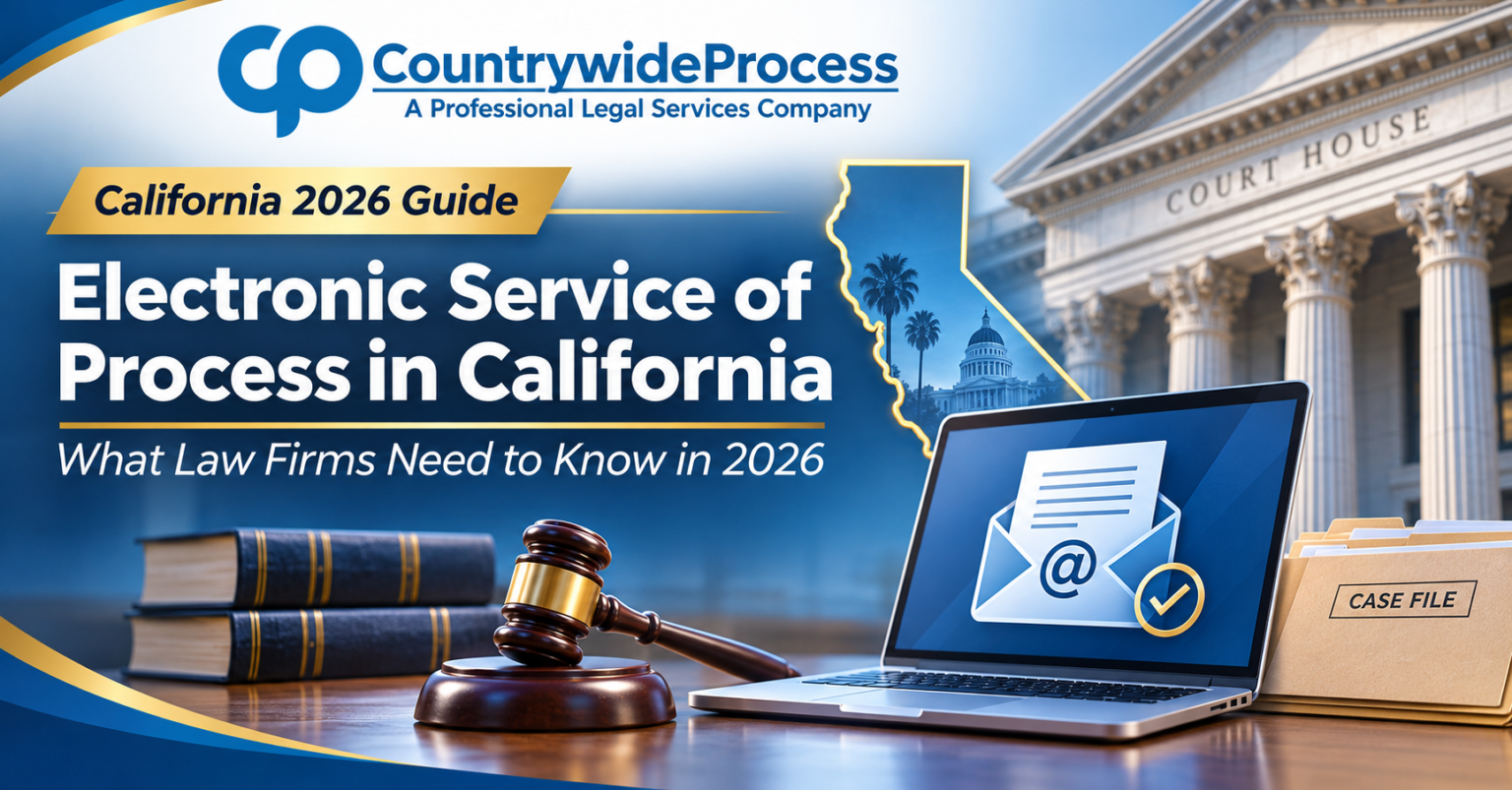
In 2026, California introduced an important change that gives courts clearer authority to approve electronic service of a summons when traditional service efforts have been unsuccessful.
This development creates new possibilities for attorneys, law firms, and legal support professionals handling difficult service-of-process cases.
California’s New Electronic Service Rules Explained
Effective January 1, 2026, California Senate Bill 85 amended California Code of Civil Procedure (CCP) § 413.30, expanding the circumstances in which a court may authorize alternative methods of serving a summons.
Under the amended law, a court may approve service through electronic mail or other electronic technology when a plaintiff has exercised reasonable diligence but has been unable to complete service through authorized traditional methods.
However, this does not mean attorneys can automatically email a summons and consider the defendant legally served.
Court authorization is required.
The plaintiff must submit a motion explaining why conventional service methods have failed and why the proposed alternative is reasonably calculated to provide actual notice to the defendant.
This change is particularly relevant to cases involving defendants who cannot be reached at known physical addresses but may still be accessible through verified digital communication channels.
Why Electronic Service Matters for Modern Litigation
Consider a business dispute in Los Angeles.
A company files a civil lawsuit against a former contractor who has relocated. The company’s process server visits the contractor’s last known residence multiple times but cannot complete service.
Further investigation indicates that the contractor no longer lives at the address. However, the contractor continues communicating through an established business email account.
Previously, the plaintiff might have needed to pursue additional service methods, potentially including service by publication if the statutory requirements were satisfied.
Under the amended CCP § 413.30, the plaintiff may ask the court to authorize service through the verified email address after demonstrating the required reasonable diligence.
If the court finds the proposed method appropriate, it may issue an order specifying how electronic service must be completed and documented.
The potential benefit is a more practical way to provide notice without relying entirely on unsuccessful physical delivery attempts.
What Counts as Reasonable Diligence?
One of the most important parts of California’s electronic service framework is the requirement to demonstrate reasonable diligence.
A court will not necessarily approve electronic service simply because sending an email is faster or less expensive.
Attorneys must establish that they have made appropriate efforts to serve the defendant through available legally authorized methods.
Evidence supporting a request for alternative service may include:
Documented Attempts at Personal Service
Process servers should maintain accurate records of unsuccessful service attempts, including dates, times, locations, and relevant observations.
Address Verification and Investigation
If the defendant cannot be located, additional investigation may help determine whether the individual has moved or maintains another address.
Skip tracing and public records research can help identify potential locations.
Consideration of Other Authorized Service Methods
Attorneys should evaluate whether substituted service, mail with acknowledgment, or other statutory methods are applicable and document why those methods were unsuccessful or unavailable.
Verification of Electronic Contact Information
Before requesting service by email, attorneys should gather evidence connecting the proposed email address to the defendant.
Recent correspondence, business communications, and other reliable records may help establish that the address remains active.
The statute requires factual details of service efforts and why available methods failed. There is no universal rule that exactly three unsuccessful visits automatically establishes sufficient diligence.
Can Legal Documents Be Served Through Email or Social Media?
California’s amended law allows courts to consider electronic communication methods, but approval depends on the circumstances of the case.
Email Service
Email may be appropriate when the requesting party can establish that the address belongs to the defendant and is reasonably likely to provide actual notice.
Other Electronic Technology
The statute also permits courts to consider other electronic methods. Depending on the circumstances, a party might propose communication through a verified digital account or a secure electronic delivery platform.
Social Media Messaging
In an appropriate case, an attorney could ask the court to consider messaging through a verified online account. However, social media service is not automatically authorized, and the plaintiff must demonstrate why the proposed method is reasonably calculated to reach the defendant.
Regardless of the technology used, the court’s order determines the approved method and proof requirements.
Electronic Service of Summons vs. Routine Electronic Service
An important distinction for legal professionals is the difference between serving the initial summons and electronically serving documents after litigation is underway.
California Code of Civil Procedure § 1010.6 and California Rules of Court rule 2.251 address electronic service of documents in civil proceedings, including consent-based and mandatory electronic service.
CCP § 413.30 addresses a different issue: court-authorized alternative service of a summons when the statutory requirements are met.
The fact that parties exchange documents electronically during litigation does not automatically authorize emailing an initial summons and complaint to a defendant.
Law firms must identify which rules govern the particular document being served.
How to Prepare for Court-Approved Electronic Service
Attorneys considering electronic service should establish a clear documentation process.
First, collect the service history.
Review all attempted deliveries and ensure that the process server’s declarations accurately describe what happened.
Second, confirm the proposed recipient’s digital identity.
An outdated email address or unverified social media account may not provide a reliable basis for alternative service.
Third, prepare the motion and supporting evidence.
The application should explain the unsuccessful traditional service efforts and why the requested electronic method is likely to provide actual notice.
Fourth, obtain the necessary court order.
Do not treat electronic delivery as valid service under this alternative procedure before receiving the court’s authorization.
Finally, preserve proof of compliance.
Follow the order’s instructions precisely and retain the required electronic delivery records, declarations, and other supporting evidence.
A well-organized record can help reduce disputes about whether the defendant was properly served.
Why Professional Process Servers Remain Important
Although California now expressly recognizes electronic service as a potential alternative, professional process servers continue to play a critical role.
In fact, the reasonable diligence requirement makes accurate service documentation especially important.
A process server’s responsibilities may include conducting physical service attempts, recording unsuccessful visits, confirming addresses, and preparing declarations describing the efforts undertaken.
These records can provide attorneys with important evidence when considering whether to request an alternative service order.
Professional legal support companies also assist with related tasks, including skip tracing, document preparation, court filing coordination, and service tracking.
For attorneys looking to understand the complete procedure, Countrywide Process provides a detailed resource explaining electronic service of process in California in 2026, including CCP § 413.30, reasonable diligence requirements, and the steps involved in requesting court-authorized electronic service.
Working with an experienced process-serving provider can make it easier to coordinate physical service attempts while preserving the documentation needed for possible alternative service.
Does Electronic Service Replace Traditional Process Serving?
No. Electronic service is not a universal replacement for personal or substituted service.
California continues to recognize its established service methods, and those procedures remain important for civil litigation.
The 2026 amendment provides an additional option in qualifying circumstances where traditional service has not succeeded.
The amended CCP § 413.30 also expressly excludes actions against governmental entities and actions against their agents or employees, whether sued in an official or individual capacity.
Attorneys should therefore evaluate the specific defendant, applicable statutes, and available service methods before choosing a strategy.
Final Thoughts
California’s 2026 changes to electronic service of process reflect the growing importance of digital communication in legal proceedings.
For attorneys struggling to locate defendants or complete service through conventional means, CCP § 413.30 offers another potential route.
However, successful electronic service still depends on reasonable diligence, reliable evidence, judicial authorization, and careful compliance with the court’s instructions.
Law firms that maintain accurate service records and work with dependable legal support professionals will be better prepared to use these procedures when appropriate.
As legal technology continues to evolve, understanding the relationship between traditional process serving and electronic alternatives will remain essential for efficient civil litigation.
Disclaimer: This article is intended for general educational purposes and does not constitute legal advice. Attorneys should review current California statutes, applicable court rules, and case-specific requirements before proceeding with electronic service.