





Summarize this blog post with:
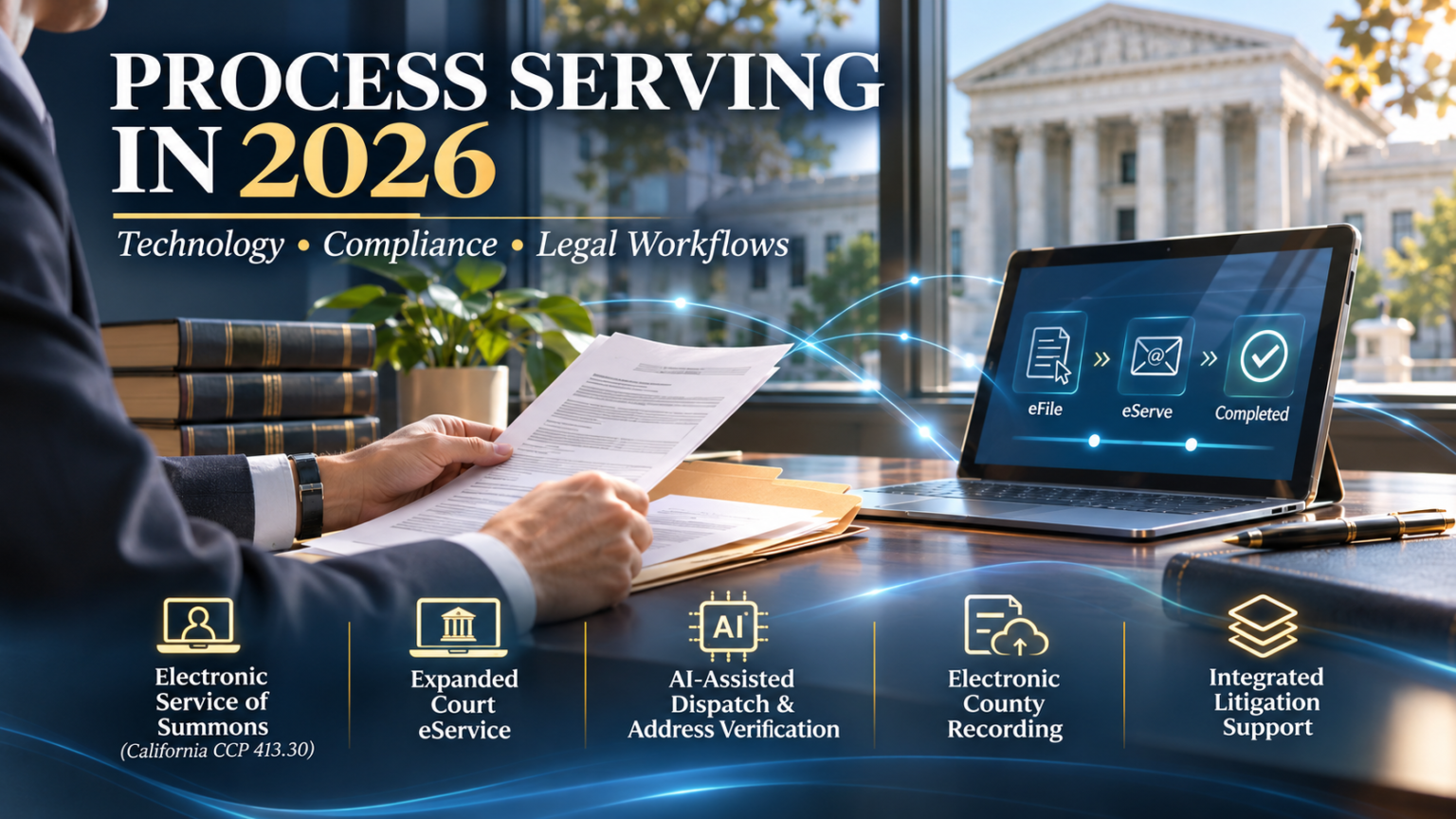
The legal industry is experiencing a significant transformation in how documents are filed, delivered, served, and tracked. In 2026, process serving is no longer simply about delivering legal papers to the correct person. It increasingly involves digital communication, court-approved electronic service, automated case management, and accurate documentation.
For attorneys and law firms, these developments create opportunities to improve efficiency while maintaining procedural compliance.
Understanding the changes affecting process serving in 2026 can help legal professionals reduce administrative delays, manage difficult service attempts, and prepare for a more technology-driven litigation environment.
1. Electronic Service of Process Is Expanding
One of the most notable legal developments of 2026 involves electronic service of legal documents.
California’s Senate Bill 85 amended Code of Civil Procedure Section 413.30, effective January 1, 2026, allowing courts to authorize alternative methods of serving summons, including email and other electronic technologies, when statutory requirements are satisfied.
This does not mean attorneys can automatically replace traditional process serving with email.
Instead, courts may authorize an alternative method when conventional service cannot be completed despite reasonable diligence, or when no applicable statutory method is provided. The proposed method must be reasonably calculated to provide actual notice.
For legal professionals, this makes thorough documentation of unsuccessful service attempts especially important.
Records of attempted service, addresses checked, and reasons for unsuccessful attempts may become essential when requesting court approval for alternative service.
The amended provision also excludes actions against governmental entities and their agents or employees.
2. Courts Are Moving Toward Digital Document Delivery
Electronic service is not limited to communication between attorneys and defendants.
Courts are also adopting digital systems to transmit notices, orders, and other legal documents.
For example, the Los Angeles County Superior Court expanded electronic service of civil case documents beginning June 2, 2025, including unlawful detainer and small claims matters.
These developments continue to influence legal operations in 2026.
Electronic document delivery can provide several advantages:
- Faster access to court notices and documents.
- Reduced dependence on traditional mail delivery.
- Improved organization of digital case records.
- Easier access to service confirmations.
- More efficient communication between courts and legal professionals.
However, attorneys must distinguish between electronic delivery of court documents and the initial service of summons.
Different legal requirements apply, and compliance with one electronic service procedure does not automatically satisfy another.
3. AI and Automation Are Improving Process Serving Operations
Artificial intelligence and workflow automation are becoming increasingly relevant to litigation support.
Although process servers still perform essential work in the field, technology can assist with the administrative steps involved in arranging and completing service.
For example, automated systems may help legal support teams identify inaccurate addresses before dispatching a process server.
Digital scheduling systems can also help coordinate assignments, while case management platforms can organize service updates and supporting documents.
Some practical applications include:
Address verification: Checking submitted addresses before scheduling field visits.
Skip tracing assistance: Using available records and research tools to help locate individuals who may have moved.
Automated dispatching: Organizing service assignments according to location, workload, and other operational requirements.
Digital tracking: Maintaining records of attempts, timestamps, and service status.
Document management: Organizing affidavits, proofs of service, and other case-related materials.
Despite these advances, technology cannot replace the professional judgment required to identify the correct person, follow applicable service laws, and prepare accurate supporting documentation.
AI-generated findings should always be independently verified before they influence a legally significant decision.
4. Electronic Recording Is Changing Litigation Support
Another important development involves electronic recording, commonly known as eRecording.
Instead of physically submitting every eligible document to a county recorder’s office, authorized users can submit certain documents electronically through supported recording platforms.
Depending on county requirements and the document involved, eRecording may be available for instruments such as property-related notices, judgments, and other recordable documents.
Potential benefits include faster submission, reduced courier expenses, and more convenient tracking of recording status.
Nevertheless, county participation, document eligibility, processing times, and acceptance requirements vary.
Law firms should confirm these details before relying on electronic recording for time-sensitive matters.
When coordinated with court filing and process serving, eRecording can help reduce the number of disconnected administrative steps involved in litigation.
5. Law Firms Are Looking for More Integrated Legal Support
Traditionally, law firms often worked with different vendors for process serving, court filing, document recording, and locating difficult-to-find individuals.
This approach can create additional administrative work, particularly when multiple vendors must coordinate around the same case deadlines.
An integrated litigation support workflow offers a different approach.
For example, a law firm may need to file a complaint, arrange service of summons, monitor service attempts, obtain the completed proof of service, and submit additional documents.
When these steps are coordinated effectively, legal teams can spend less time following up with multiple service providers.
Companies such as Countrywide Process provide litigation support services that include process serving, court eFiling, eRecording, and skip tracing.
The company’s detailed analysis, The State of Process Serving in 2026: Five Statutory and Operational Changes Reshaping the Legal Support Industry, explores the regulatory and operational developments influencing the industry.
For law firms reviewing their existing service providers, the key consideration should be whether a provider can combine modern technology with dependable operational procedures and clear documentation.
Why Compliance Still Matters More Than Speed
While digital tools can improve efficiency, the fundamental legal requirements surrounding service of process remain essential.
Attorneys must ensure that documents are served according to the applicable jurisdiction’s rules, deadlines are properly monitored, and service records accurately reflect what occurred.
A faster workflow offers little benefit if errors result in a challenged service, additional expense, or procedural delays.
Legal teams should therefore evaluate service providers based on reliability, transparency, familiarity with applicable procedures, and the quality of their documentation—not technology alone.
What Law Firms Should Do Next
As litigation support continues to modernize, attorneys and legal administrators should consider reviewing their current workflows.
A practical review might include examining how service attempts are documented, whether court notifications are monitored consistently, how service providers communicate updates, and whether existing tools support accurate recordkeeping.
Firms should also review relevant changes in state laws and local court rules rather than assuming electronic service procedures are identical everywhere.
Final Thoughts
Process serving in 2026 is evolving toward a more connected, technology-supported legal environment.
Electronic service, digital court communication, automated dispatching, and integrated litigation support are creating new opportunities for efficiency.
However, the most effective approach combines these advancements with experienced professionals, accurate records, and careful attention to legal requirements.
For attorneys and law firms, the goal should not simply be faster service. It should be a reliable, transparent, and legally compliant process that supports better case management from beginning to end.
Disclaimer: This article is intended for general informational purposes and does not constitute legal advice. Always verify current statutes, court rules, and jurisdiction-specific requirements.