





Summarize this blog post with:
Winning a court judgment is often only half the battle; the real challenge lies in the collection. For attorneys in California, one of the most effective tools for judgment enforcement is the Bank Levy. However, procedural nuances vary significantly from county to county.
If you are practicing in Northern California, understanding the specific requirements for Alameda County is critical to avoid delays that could allow a debtor to move funds.
The Alameda County “Sheriff Hybrid” Model
In many jurisdictions, the Sheriff’s Office handles the entire levy process. However, Alameda County operates under a specific model where the Sheriff’s Civil Unit acts primarily as the levying officer (the administrator of the funds), but typically does not perform the physical service.
Unless your client has a certified fee waiver or is currently incarcerated, you cannot rely on the Sheriff to walk the papers into the bank. This is where most attorneys hit a wall if they aren’t prepared with a private service partner.
Critical Steps for a Successful Levy
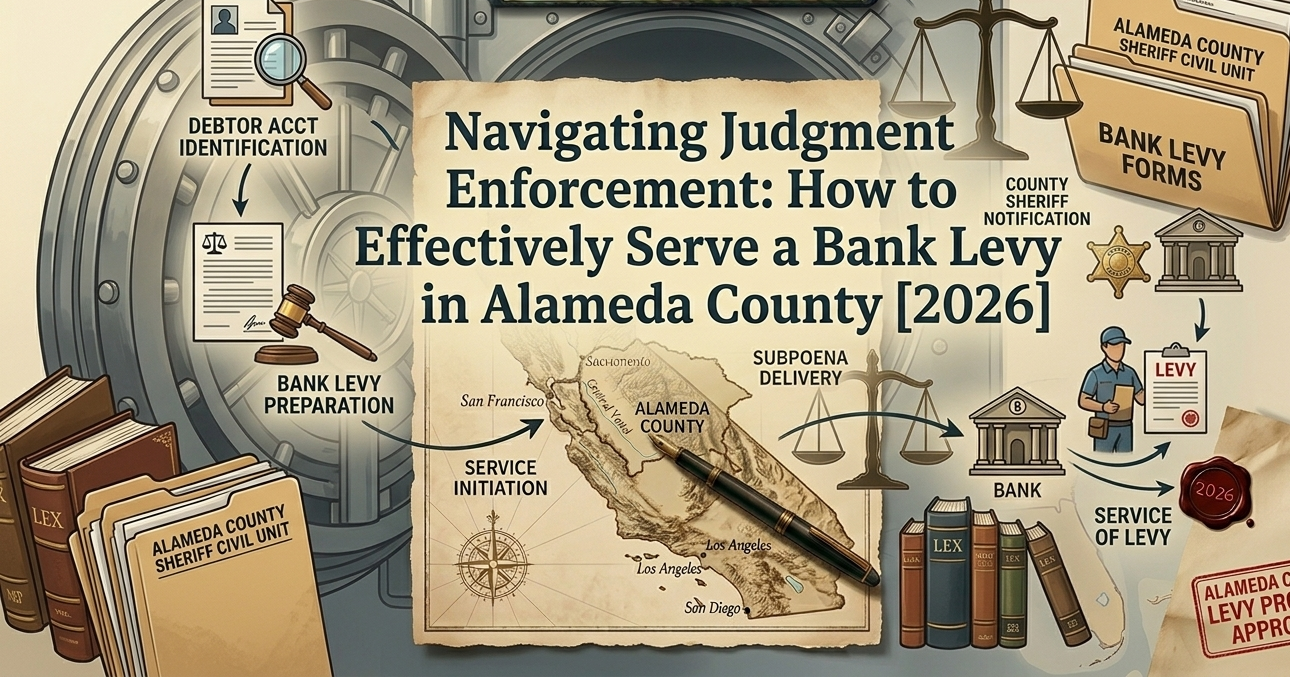
To successfully freeze a debtor’s assets in Alameda, your firm must follow a strict multi-step workflow:
- Open the Civil File: You must first submit your Writ of Execution (EJ-130) and the mandatory SER forms to the Sheriff’s Civil Division to open a case file.
- Coordinate with a Private Process Server: Because the Sheriff won’t serve the bank directly, you must hire a Registered Process Server (RPS) to deliver the Notice of Levy (EJ-150) to the specific bank branch.
- The Two-Set Rule: One of the most common mistakes is failing to provide enough documentation. You must serve two sets of levy papers—one for the financial institution and one for the judgment debtor.
- Proof of Service: Once the bank is served, the Proof of Service must be returned to the Sheriff immediately. The Sheriff will not process any recovered funds until this document is in their hands.
Why Precision Matters
The timeline for a bank levy is unforgiving. Under 2026 California guidelines, the bank has 10 days to respond once served, and the debtor has a strict window to file a Claim of Exemption (15 days if served personally, 20 if by mail). Any clerical error in your Letter of Instruction or a delay in returning the Proof of Service can result in the Sheriff closing the file, forcing you to start—and pay for—the process all over again.
Expert Resources for California Attorneys
Navigating the intersection of the Sheriff’s requirements and private process service requires a partner who understands the local landscape.
For a comprehensive, step-by-step technical breakdown—including a list of required forms like the SER-001 and SER-001A—we highly recommend reviewing the How to Serve a Bank Levy in Alameda County: 2026 Attorney Guide provided by the experts at Countrywide Process.
Countrywide Process has established itself as a leader in California legal support, offering three generations of experience in service of process, e-filing, and specialized judgment enforcement. Whether you need to domesticate a subpoena or execute a complex levy, their team ensures that your filings meet the exact standards of the Alameda County Sheriff’s Civil Unit.
Don’t let a procedural technicality stand between your client and their recovery. Ensure your levy is served right the first time.